Artigo de periódico
A interpretação das decisões trabalhistas
| dc.contributor.author | Capiotto, Gabriele Mutti | pt_BR |
| dc.contributor.author | Mendes, Anderson Cortez | pt_BR |
| dc.date.accessioned | 2026-01-26T17:47:09Z | |
| dc.date.available | 2026-01-26T17:47:09Z | |
| dc.date.issued | 2024-12 | |
| dc.identifier.citation | CAPIOTTO, Gabriele Mutti; MENDES, Anderson Cortez. A interpretação das decisões trabalhistas = The interpretation of labor decisions. Revista do Tribunal do Trabalho da 2ª Região, São Paulo, v. 16, n. 32, p. 33-51, jul./dez. 2024. | pt_BR |
| dc.identifier.uri | https://hdl.handle.net/20.500.12178/259752 | |
| dc.description.abstract | [por] A fundamentação do comando decisório traz os contornos da coisa julgada que podem desbordar à objetividade do dispositivo. As plurissignificações geradas nesse conteúdo de linguagem fazem despontar a necessidade de analisar a interpretação dos provimentos jurisdicionais, os seus sentidos e significados, considerado o diálogo que instala com as partes, outros juízes e terceiros. Nessa linha de ideias, analisa a interpretação das decisões trabalhistas. Faz uma breve exposição sobre a semiótica e a interpretação em geral. Na sequência, examina a importância da exegese das decisões judiciais. Por fim, arrola os critérios hermenêuticos que devem ser utilizados pelo intérprete em sua função, extraídos das obras dos principais juristas que se debruçaram sobre o tema. Conclui, então, que a decisão deve ser interpretada em sua integralidade, com a quebra do dogma da prevalência do dispositivo sobre as suas outras partes. Sustenta, ainda, a importância do intérprete tomar em conta todos os elementos constantes dos autos processuais no exercício de sua tarefa. | pt_BR |
| dc.description.abstract | [eng] The reasons of the decision-making command brings the contours of res judicata that may overflow the objectivity of the device. The multiple meanings generated in this language content highlight the need to analyze the interpretation of jurisdictional provisions and their meanings, considering the dialogue it establishes with the parties, other judges and third parties. Along these lines of ideas, this article analyzes the interpretation of labor decisions. Provides a brief presentation on semiotics and interpretation in general. In sequence, it examines the importance of exegesis of judicial decisions. Finally, it lists the hermeneutical rules that must be used by the interpreter in his function, extracted from the works of the main jurists who have studied the topic. It concludes, then, that the decision must be interpreted in its entirety, breaking the dogma of the prevalence of the conclusion over its other parts. It also supports the importance of the interpreter taking into account all the elements contained in the case-file in carrying out its task. | pt_BR |
| dc.description.tableofcontents | Semiótica e interpretação -- A interpretação das decisões judiciais -- Critérios hermenêuticos para a interpretação das decisões trabalhistas | pt_BR |
| dc.language.iso | pt_BR | pt_BR |
| dc.relation.ispartof | Revista do Tribunal do Trabalho da 2ª Região: vol. 16, n. 32 (jul./dez. 2024) | pt_BR |
| dc.subject | Decisão judicial, Brasil | pt_BR |
| dc.subject | Processo trabalhista, Brasil | pt_BR |
| dc.subject | Hermenêutica, Brasil | pt_BR |
| dc.title | A interpretação das decisões trabalhistas | pt_BR |
| dc.title.alternative | The interpretation of labor decisions | pt_BR |
| dc.type.genre | Artigo de periódico | pt_BR |
| dc.relation.ispartoflink | https://hdl.handle.net/20.500.12178/250998 | pt_BR |
| dcterms.accessRights | Acesso aberto | pt_BR |

Coleção
-
Artigos9847
Veja também
-
Processo estrutural trabalhista: limites e possibilidades da atuação judicial
[por] Propõe as bases para a construção de uma doutrina brasileira do processo estrutural laboral. Parte-se da hipótese de que a seara laboral é vocacionada a situações complexas que demandam intervenção estrutural do poder judiciário para a pacificação dos conflitos e está familiarizada com essas situações. Para tanto, ... -
As recentes decisões do Supremo Tribunal Federal (STF) que reconhecem a validade das relações jurídicas diversas da relação de emprego
[por] A adoção dos postulados e do modelo de Estado neoliberal impactam de forma direta e decisiva na ordem jurídica brasileira, inclusive, em relação à interpretação e a aplicação dos direitos nas relações de trabalho. O objetivo principal desse trabalho consiste em apresentar uma abordagem crítica sobre como a ... -
Ativismo judicial
[por] Aborda alguns aspectos relevantes do chamado ativismo judicial. Inicialmente, faz uma rápida passagem sobre a Teoria Geral do Direito, analisando o Estado Democrático de Direito e os conceitos de justiça, validade e eficácia das normas jurídicas. A seguir, adentra ao tema do ativismo judicial em sentido estrito, ... -
Proteção da maternidade nas relações de trabalho e a jurisprudência do Supremo Tribunal Federal
[por] Pesquisa a igualdade entre homens e mulheres. Não só ao reconhecimento constitucional, mas também por normas internacionais, e a necessidade de eliminar a discriminação no trabalho. Analisa o papel essencial da amamentação como fundante da importância das mulheres na manutenção da espécie. Todas as condições ... -
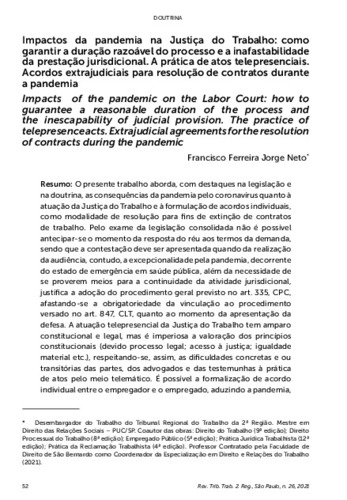
Impactos da pandemia na Justiça do trabalho: como garantir a duração razoável do processo e a inafastabilidade da prestação jurisdicional. A prática de atos telepresenciais. Acordos extrajudiciais para resolução de contratos durante a pandemia
[por] Aborda, com destaques na legislação e na doutrina, as consequências da pandemia pelo coronavírus quanto à atuação da Justiça do trabalho e à formulação de acordos individuais, como modalidade de resolução para fins de extinção de contratos de trabalho. Pelo exame da legislação consolidada não é possível antecipar-se ... -
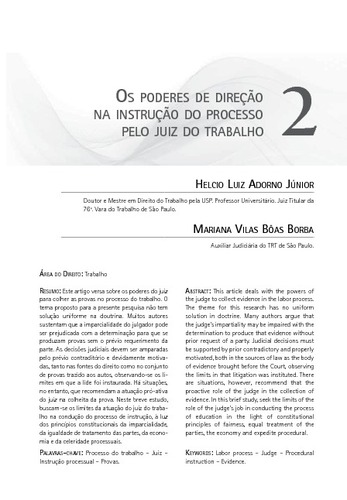
Os poderes de direção na instrução do processo pelo juiz do trabalho
[por] Versa sobre os poderes do juiz para colher as provas no processo do trabalho. O tema proposto para a pesquisa não tem solução uniforme na doutrina. Muitos autores sustentam que a imparcialidade do julgador pode ser prejudicada com a determinação para que se produzam provas sem o prévio requerimento da parte. As ... -
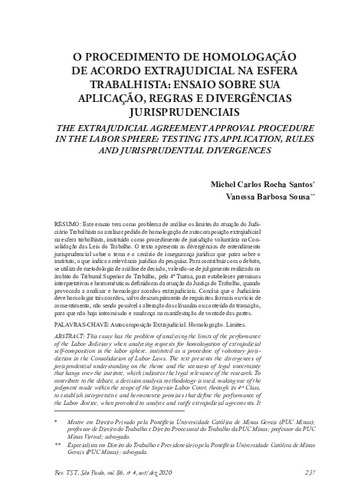
O procedimento de homologação de acordo extrajudicial na esfera trabalhista: ensaio sobre sua aplicação, regras e divergências jurisprudenciais
[por] Tem como problema de análise os limites da atuação do Judiciário Trabalhista ao analisar pedido de homologação de autocomposição extrajudicial na esfera trabalhista, instituído como procedimento de jurisdição voluntária na Consolidação das Leis do Trabalho. Apresenta as divergências de entendimento jurisprudencial ... -
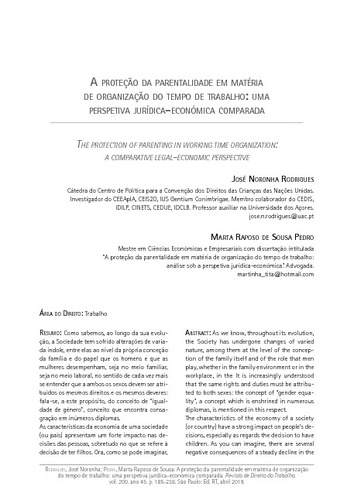
A proteção da parentalidade em matéria de organização do tempo de trabalho: uma perspectiva jurídica-econômica comparada
[por] Como sabemos, ao longo da sua evolução, a Sociedade tem sofrido alterações de variada índole, entre elas ao nível da própria conceção da família e do papel que os homens e que as mulheres desempenham, seja no meio familiar, seja no meio laboral, no sentido de cada vez mais se entender que a ambos os sexos devem ser ... -
O papel da jurisdição no combate ao assédio moral: decisões paradigmáticas e acesso à justiça
[por] Analisa a função da jurisdição constitucional no acesso à justiça e defesa de trabalhadores vulneráveis, com foco no assédio moral no trabalho, caracterizado por ações repetitivas e abusivas que comprometem a saúde física e emocional do empregado. A Constituição de 1988, por meio do princípio da proteção, oferece ... -
O impacto na execução trabalhista das recentes reformas legislativas relacionadas à desconsideração da personalidade jurídica
[por] É fato notório que a fase de execução é o gargalo à efetivação dos direitos dos trabalhadores no processo trabalhista brasileiro. O legislador, todavia, ao realizar alterações legislativas de ordem processual (Novo CPC e reforma trabalhista) e material (Lei de liberdade econômica), alterou a sistemática de um ...